
Albanian Beginner Vocabulary
Albanian Mistakes That Change What You Said
In Albanian the ending carries the article and one small particle carries the mood. These are the beginner slips that change meaning, not accent.
In Albanian the ending carries the article and one small particle carries the mood. These are the beginner slips that change meaning, not accent.
Albanian is forgiving about accent and unforgiving about endings. You can mangle the vowels and people will follow you perfectly well. Attach the wrong suffix to a noun, or leave out a two letter particle in front of a verb, and you have said something different from what you meant, confidently, and almost nobody will stop you to explain.
That is the shape of the beginner problem in Albanian. The errors that matter are not the ones that sound foreign. They are grammatical switches: the article lives on the end of the noun, and the mood of the verb lives in a word before it. Both are small, both are easy to drop, and both change the sentence.
Each pair below is written so you can hear the difference rather than only read it. Play the two cards one after the other. The respellings are approximations and nothing more: Albanian has an ë that is a flat unstressed uh, a y with no English equivalent at all (closest to the u in French tu), and a q that sits between the ch of cheap and a hard k. No English spelling can carry those honestly.
There is no separate word for the in Albanian. Definiteness is a suffix, usually -i or -u on masculine nouns and -a on feminine ones. A dictionary will give you the indefinite form. A sign, a menu or a person talking to you will very often give you the definite one, which is why the word you learned and the word you hear do not match.
The place where this actually bites is after the verb to be. Albanian says a job or a role with no article, exactly as English does not. Add the definite ending and you have claimed to be a specific, previously mentioned person.
Jam studenti is not wrong Albanian. It means I am the student, the one you were talking about. Said to a receptionist who has never heard of you, it is a small puzzle rather than an answer. The same logic runs after common prepositions, where the plain indefinite form is what you want unless something follows it.
This also explains the country name. Shqipëri is the bare form and Shqipëria is the definite one, and English borrowed the definite form of the capital, Tirana, from Tiranë.
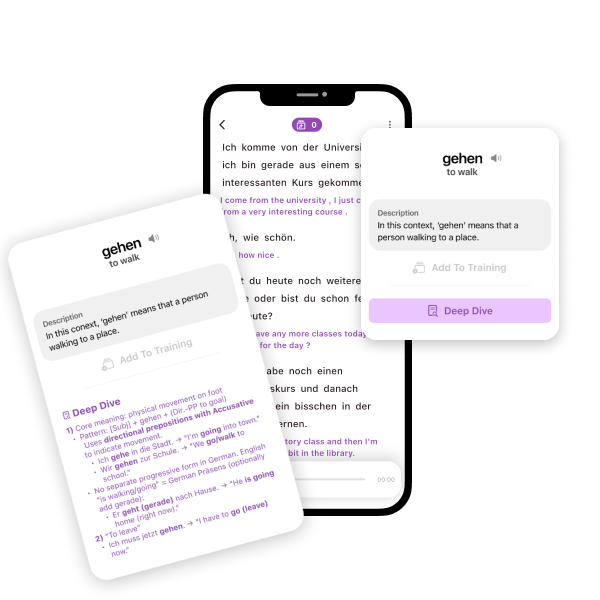
Photograph a sign, a menu or this page. LiT reads it, translates it, and sends the words you want to keep into your vocabulary trainer.
Try LiT Free

This is the single most productive source of accidental meaning in beginner Albanian. The word do is the second and third person singular of dua, to want. It is also the marker of the future tense, but only when it is followed by të.
Drop the të from a future sentence and you have not produced a slightly broken future. You have produced a statement about wanting, with the verb stranded after it. In fast speech the të is often squeezed down to almost nothing, which is why learners decide it is optional. It is not optional. It is just quiet.
Standard Albanian has no infinitive. Where English uses to go, Albanian uses të plus a fully conjugated verb, so I want to go is literally I want that I go. Leave out the të and you have two finite verbs next to each other with nothing joining them.
The other particle worth knowing early is po. On its own it means yes. In front of a verb it marks something happening right now, which is why answering a phone with po vij is not saying yes twice.
Albanian splits negation by mood. Nuk, often shortened to s' in speech, negates ordinary statements. Mos negates commands, wishes and subjunctives. Swapping them does not produce a milder or stronger version of the same thing; it produces a sentence in the wrong mood.
If you only remember one thing: anything you are telling someone not to do starts with mos.
Albanian has a mood that most European languages do not, usually called the admirative. It takes an ordinary statement and adds surprise, or marks it as something you have just found out or been told. It is formed from the participle plus endings built on the verb to have, and the common ones are short and very frequent.
You are unlikely to produce these by accident as a beginner. You are very likely to mishear them, decide they are a tense you have not learned, and miss that the speaker is reacting rather than reporting. Used about a person, the surprise can read as doubt, so it is a mood to recognise long before you start using it.
Albanian also keeps a living optative mood, used for blessings and, just as productively, for curses. Most learners meet it without noticing, because the standard goodbye is one.
The practical rule is to learn optative forms as fixed phrases and not to build new ones from a pattern. The same endings carry the curses, and the line between a blessing and its opposite is a single verb.
Albanian separates ti, one person you know, from ju, which is both the plural and the polite singular. Using ti with an official, a shopkeeper well older than you, or anyone in a formal setting is not rude exactly, but it places you. Nobody will mention it.
The other near miss is in thanks. Faleminderit is thank you, and ju lutem covers both please and you are welcome, so it is the reply as well as the request. Answering faleminderit with faleminderit leaves the exchange hanging.
One last thing that is not a phrase. The head gesture for yes and no is widely reported to run opposite to the English one in parts of Albania and Kosovo. It is not consistent, and people often switch once they realise they are talking to a foreigner, which makes it less reliable rather than more. Say po or jo out loud and the ambiguity disappears.
Standard Albanian is built mainly on Tosk, the southern group. Gheg is spoken across northern Albania, Kosovo and North Macedonia, and it is a dialect group rather than an accent. Two differences matter to a learner immediately. Gheg drops many final ë sounds and has nasal vowels that standard Albanian does not, and Gheg has a real infinitive formed with me, so where the standard says të shkoj you will hear me shku.
Everything in this article is standard Albanian and is understood everywhere. What changes is what you hear back.
The phone greeting is alo, borrowed and used for nothing else. It is normal and it is not rude, although it looks abrupt written down.
Writing is where two of the mistakes above become visible that would have passed unnoticed in speech. The ë that people swallow in conversation has to be typed, and leaving it off changes the written word; a keyboard without ë is the most common reason learners end up with the wrong form on the page. In formal writing Ju is capitalised when it is the polite singular, which is a small courtesy with no spoken equivalent. In messages between friends none of this holds, ë disappears, and tung does the work of both hello and goodbye.
| Form | What it means | Use it when |
|---|---|---|
| libër | a book | no article in English |
| libri | the book | the one already mentioned |
| do plus a noun | wants | A do kafe? Do you want coffee? |
| do të plus a verb | will | Do të pi kafe. I will drink coffee. |
| nuk | not, in a statement | Nuk vij. I am not coming. |
| mos | not, in a command or wish | Mos u shqetëso. Do not worry. |
| është ftohtë | it is cold, flat fact | giving the weather |
| qenka ftohtë | it is cold, and that surprises me | stepping outside |
Fix two things first and most of your sentences stop meaning the wrong thing: keep të after do when you mean the future, and use mos rather than nuk for anything you are telling someone not to do. After that, get comfortable with the difference between libër and libri, because the article on the end of the noun is working in every sentence you say.
The admirative and the optative are for recognising, not producing. Learn mirupafshim as a word, hear qenka as a reaction, and leave the rest of those endings alone until you have heard them used for a while.

In an Albanian market the tag says 500 and the seller says five thousand. Here is why, plus the number words and haggling phrases that sort it out.
In Czech the ending does the work. Six beginner errors that do not just sound foreign, they change who you are speaking to and what you actually said.
The dual, the cases and one small vowel. Six beginner slips in Slovenian that do not just sound foreign, they tell the other person something you never…