
Kazakh Beginner Vocabulary
Asking Directions in Kazakh, and Parsing the Answer
Қайда gets you the question out. The answer is the hard part, so here are the direction words, landmarks and verb endings you need to act on what you hear.
Қайда gets you the question out. The answer is the hard part, so here are the direction words, landmarks and verb endings you need to act on what you hear.
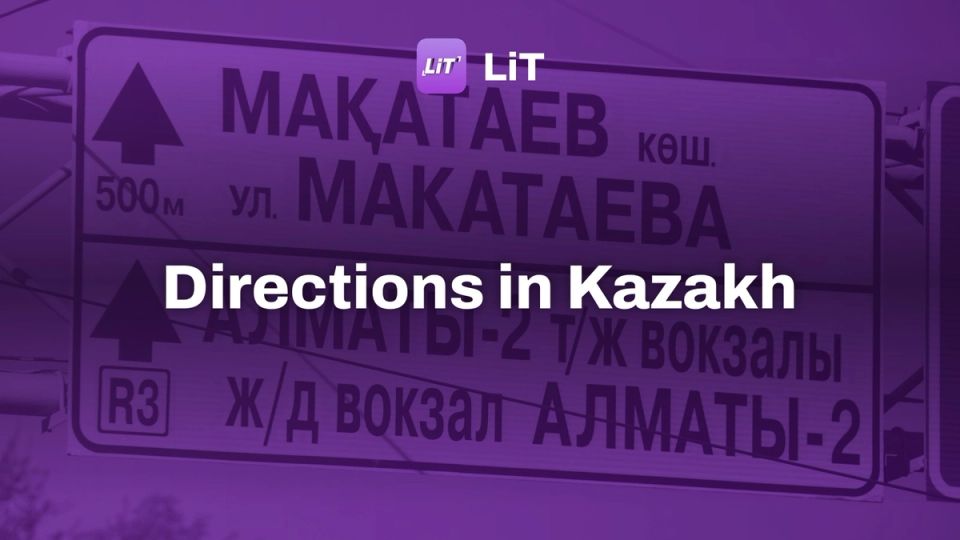
Most people learn the question and stop there. You walk up to someone in Aktobe, produce a clean sentence with қайда on the end, and then stand still while a fluent forty word reply goes past you. The question is the easy half. The half that matters is being able to pick four or five known words out of the answer and start walking in the right direction.
Kazakh helps you here more than you expect, because the instruction almost always lands at the end of the sentence. The landmark comes first, the thing you are meant to do comes last. English does it the other way round: turn left at the lights. Kazakh gives you the lights, then the turning. If you train yourself to wait for the final word, you get the verb, and the verb is the part you can act on.
Tap the play button on any phrase below and say it back. Kazakh stress sits on the last syllable of the word almost every time, and hearing that once fixes more than reading about it will.
Kazakh separates сен, the singular you, from сіз, the polite and plural one, and the split runs through the verb endings rather than sitting in a separate pronoun. Everything you say to a stranger should carry the -ңыз or -ңіз ending. It is the difference between a polite request and an instruction you have no standing to give.
The bare form, кешір, exists and is what you would say to a friend or a child. To a bus driver or a woman running a fruit stall it lands badly. Learn only the long one and you will never have to think about it.
Photograph a sign, a menu or this page. LiT reads it, translates it, and sends the words you want to keep into your vocabulary trainer.
Try LiT Free


There is no verb to conjugate and no preposition to place. You name the thing and you add қайда, which means where, in the sense of where at. Word order does the rest.
The other question shape worth having is the yes or no one. Kazakh marks a yes or no question with a small particle at the end, and that particle changes shape to match the sound before it, appearing as ма, ба or па. You do not need the rule to use the fixed phrases below, but you do need to recognise that a sentence ending in one of those little syllables is a question aimed at you.
If you catch nothing else, catch these. They carry the whole direction and they are short enough to hear over traffic.
The -ға on the end of оң and сол is the ending that means towards. You will hear the same ending attached to landmarks, and it always means motion in that direction rather than being there. Note also that сол on its own is the ordinary word for that, so the bare syllable is not always about the left hand side. In a direction, it will have the ending on it.
Kazakh does not put a small word in front of the landmark the way English puts at, to or past. It glues an ending on the back. This is why answers sound like a solid wall of sound: the information you want is in the last two syllables of a word you have already stopped listening to.
Three endings do most of the work. A word ending in -да or -де means at or in that place. A word ending in -ға or -ге followed by дейін means as far as it. A word ending in -дан or -нан followed by кейін means after it. Hearing дейін or кейін tells you a landmark just went past, even if you missed which one.
Wait for the end of the sentence and you get the verb, and the verb tells you what to do with your feet. The polite ones all end in that same -ңыз or -ңіз you are already using. Бұрылыңыз is turn, жүріңіз is go or walk, өтіңіз is cross or go past, отырыңыз is sit and by extension get on, түсіңіз is get off.
Two more questions save you a long walk or an unnecessary taxi. The answer to the first is usually one word, either жақын for near or алыс for far, and you can read most of it off the person's face anyway.
The first mistake is dropping the polite ending. Бұрыл instead of бұрылыңыз, кешір instead of кешіріңіз. Nobody will say anything, but you have addressed an adult stranger the way you would address a nine year old.
The second is қайдан instead of қайда. They look like the same word with a tail, and they are not. Қайда is where at, қайдан is where from. Сіз қайдансыз means where are you from, which is a perfectly friendly thing to be asked and a confusing thing to ask about a railway station.
The third is trusting a respelling too far. Kazakh has қ and ғ made further back in the throat than any English k or g, ң at the end of syllables, and three vowel pairs, ұ against ү, ы against і, that English has no way to write apart. The respellings on this page are a crutch to get you moving. They are not a description of the sounds, and the audio is doing the real work.
Kazakhstan is genuinely bilingual and the balance shifts as you move across it. In the south and west, around Shymkent, Turkistan, Kyzylorda and Aktobe, you are more likely to get an answer entirely in Kazakh. In Almaty and in the northern cities, Russian is heavily used in everyday life, and a lot of people will answer in whichever language reaches you fastest. Kazakh is also spoken outside the country, in Bayan-Olgii in western Mongolia and in Xinjiang in China, where it is written in an Arabic-based script rather than Cyrillic.
What you will hear most often is neither one language nor the other. A single reply can start in Kazakh, name the landmark in Russian, and finish with a Kazakh verb. Direction words in particular are borrowed both ways, so it is worth knowing the Russian set by ear even if you never say them.
Bus and minibus numbers are frequently given in Russian as well, even inside an otherwise Kazakh sentence. If you are learning numbers, learn both sets.
Phones are answered with алло, the same as in Russian, and not with a greeting. If someone calls to find you, expect қайдасың or қайдасыз, meaning where are you, which is the same қайда with a you ending on it. That is the one time the bare question word is aimed at a person rather than a place.
In practice a lot of direction-asking has moved into ride-hailing apps, where you type an address instead of speaking it. Addresses run street name first, number second: көше means street, даңғыл means avenue, and the number follows. Many streets were renamed after 1991 and some have been renamed again since, so an older resident may give you a name that no longer matches the sign or the map. If you get a name that fails in the app, ask for the nearest crossing street instead.
On the alphabet: Kazakh is written in Cyrillic, with nine extra letters that Russian does not have. An official switch to a Latin alphabet has been announced and repeatedly rescheduled, and you will see Latin on some signage and branding, but Cyrillic is still what is on the street plates and in the maps. In casual typing, you may also see people substitute plain Russian letters for the special ones, so do not expect every written form to match the textbook.
| Situation | Say this | Note |
|---|---|---|
| Stopping a stranger | Кешіріңіз | Always first, always the long polite form |
| Naming a place | ... қайда? | Place first, question word last |
| Checking something is nearby | ... бар ма? | Yes or no, easy to read off a face |
| You are lost | Мен адасып қалдым | Works without needing a place name |
| Judging the distance | Алыс па? | Reply is usually жақын or алыс |
| Deciding whether to walk | Жаяу баруға бола ма? | Saves a taxi you did not need |
| Listening to the reply | бұрылыңыз, жүріңіз, түсіңіз | Turn, go, get off. Wait for the last word |
Learn кешіріңіз, the қайда pattern, and the three words тура, оңға and солға, and you can both ask and act. Add алыс па so you know whether to walk.
After that, the useful habit is not vocabulary but timing: hold on until the end of the sentence, because that is where Kazakh keeps the instruction.
