
Slovak Beginner Vocabulary
The First Five Questions Slovaks Will Ask You
Small talk in Slovakia follows a script. Here are the five questions strangers open with, and the answers that keep the conversation alive.
Small talk in Slovakia follows a script. Here are the five questions strangers open with, and the answers that keep the conversation alive.
Small talk in Slovakia is more predictable than you would expect. Once a stranger has decided to talk to you, and has worked out that you are not local, the same five questions arrive in roughly the same order: how are you, where are you from, do you speak Slovak, how long have you been here, and how do you like it. Taxi drivers, neighbours in the stairwell, the man at the next table in a pub in Banská Bystrica. The script barely changes.
What learners get wrong is not the answers. It is that they prepare only the answers. You say where you are from, the other person nods, and the exchange stops dead because nothing was handed back. Slovak small talk runs on two words, A vy, meaning and you, and without them you are filling in a form rather than talking to someone.
The second thing that goes wrong happens before any question is asked. Slovak has two words for you, and most apps teach the informal one first because it is shorter. Point it at a stranger twice your age and you have made a social claim you did not intend. Tap play on any phrase below, say it back, and keep an eye on which column of the table it comes from.
Nobody asks you how you are until they have greeted you. Dobrý deň is the all-purpose formal hello and it covers most of the waking day; Dobrý večer takes over in the evening. Dobré ráno exists but has a narrower life than English good morning, so Dobrý deň will not sound wrong at nine in the morning.
You greet rooms, not individuals. A small shop, a doctor's waiting room, a lift, a train compartment, the stairwell of a block of flats: one Dobrý deň into the air covers everyone in it, and saying nothing is noticed. You will also hear it clipped to just Dobrý. That is normal and slightly casual, and it is worth copying only after someone has said it to you first.
Two notes on the respellings on this page. Capitals mark stress, and in Slovak the stress is on the first syllable of a word, always, with no exceptions worth your attention. The accents in the Slovak spelling are not stress marks, they mark length, which is why doubled vowels appear in the respellings where a Slovak word has á, é, í, ó, ú or ý. Separately, d, t, n and l go soft before e and i, so deň sounds like dyen, and ch is the rasp in Scottish loch.
This is question one, and it follows the greeting rather than replacing it. You cannot walk into a bakery and lead with it. It is for someone who has already decided to have a conversation with you: a neighbour, a colleague, a host, the person sharing your table.
The question is less of a ritual than the English one. A real answer is welcome, including a middling one. Ujde to and ide to both mean something like it is going along; ako-tak is so-so; nič moc is not great. None of these will worry anyone or oblige you to explain. What does land oddly is answering brilliantly every time and then stopping, which reads as a closed door rather than good cheer.
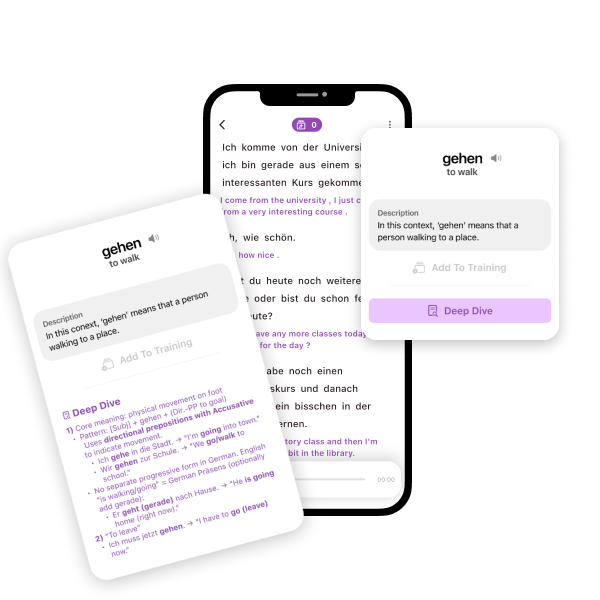
Photograph a sign, a menu or this page. LiT reads it, translates it, and sends the words you want to keep into your vocabulary trainer.
Try LiT Free

Question two arrives within about a minute of question one. The answer uses z plus the genitive, so the country name changes shape: Anglicko becomes z Anglicka, Írsko becomes z Írska. Where the next word starts with s, z, š or ž, the preposition stretches to zo, which is why it is zo Spojených štátov for the United States and zo Škótska for Scotland.
Cities behave the same way: Som z Londýna, som z Manchestru. If the ending defeats you, name the city in its English form and move on; nobody is marking you. Then hand it back with A vy ste odkiaľ, and expect the follow-up, because the next question is almost always which part, and after that whether you have been anywhere outside Bratislava.
Question three is the one you can accidentally answer in a way that ends the conversation. Nie, meaning no, is true and final. Len trochu, učím sa does the same job and opens a door, because the other person now knows to slow down rather than switch to English.
Note the shape po slovensky. It is an adverb, speaking Slovak-ly, not the name of the language, and the same pattern gives you po anglicky and po nemecky. One warning for anyone who has picked up phrases in Prague: Slovak is not Czech. Slovaks will understand jak se máš perfectly well and will also hear instantly that you learned it somewhere else.
Questions four and five usually arrive together, and they are the point where you cannot avoid Slovak grammar any longer, because talking about yourself in the past tense means marking your own gender. A man says prišiel som, a woman says prišla som. The same split runs through bol som and bola som.
Dlho has no vowel letter in its first syllable, and it does not need one: Slovak lets l and r carry a syllable on their own, which is the same thing happening in vlk and prst. Say it as a hummed L.
On the liking question, a bare yes is polite and dead. Name one thing. A town, a castle, the trains, the mountains, the fact that the buses actually turn up. The conversation then becomes about that thing, which is what the question was for.
Two more questions hover near the edge of this set. Čo robíte can mean what do you do for a living or what are you doing right this minute, and context decides. Kde pracujete has only one meaning.
Vykanie is addressing someone with vy, the plural used as a polite singular, and it is the default with everyone outside your own circle: shop staff, officials, landlords, doctors, anyone a generation above you, anyone at work you have not been introduced to properly. Tykanie, the ty forms, is for friends, family, children and people who have offered it.
The offer is a real moment with a real sentence attached, and it usually comes from the older or more senior person. Until you hear it, stay on vy. The cost of staying formal is nothing at all; the cost of the other mistake is that a fifty-year-old neighbour hears a stranger talking to her the way her nephew does.
Two specific errors to avoid. The first is the mismatch inside one breath, Dobrý deň followed by ako sa máš, formal hello and informal question glued together, which is exactly what it sounds like. The second is asking a shop assistant how they are. The transaction greeting is Dobrý deň, then what you want, then ďakujem; an ako sa máte at the till is an American habit in Slovak clothes. Among people in their twenties in a bar none of this is enforced, and ty often goes both ways from the first sentence. Match what is said to you.
The five questions are the same everywhere, but what surrounds them is not. In Bratislava and the west you will hear servus as a casual hello and goodbye, a leftover from the Austro-Hungarian Latin greeting, alongside čau and papa for bye. It is friendly, not formal, and it belongs with ty.
Standard Slovak is built on the central dialects, and the further east you go the further ordinary speech moves from it. Around Prešov and Košice the vowels shift and the stress pattern of the local dialect can fall later in the word, closer to Polish, which is disorienting when you have trained your ear on first-syllable stress. Everyone there understands and speaks standard Slovak with you; it is their conversation with each other that will sound unfamiliar.
In the south, in towns such as Komárno and Dunajská Streda, a large Hungarian-speaking community means the answer to your Dobrý deň may come in Hungarian first. And almost every Slovak follows Czech without effort, so a conversation can slide between the two languages with nobody remarking on it.
Slovaks do not answer the phone with a greeting. They answer with Prosím, the same word that means please, or with Haló, or by simply saying their surname. Businesses answer with the company name. As the caller you give the greeting and your name straight away: Dobrý deň, tu Elliot, literally here Elliot.
Calls end with dopočutia, DO-po-chu-tya, until hearing, where a face to face parting takes dovidenia, until seeing. Using dovidenia on the phone is a small, very visible tell.
In writing the first thing to go is the diacritics. Ako sa mas, odkial si and dakujem are all ordinary in a text message, and nobody reads that as illiteracy. What does not get dropped is anything else, and that is worth noticing: Slovak verbs carry the person in the ending, so there is no pronoun to delete the way English deletes the I in got your message. The questions arrive in texts looking almost exactly as they sound. Vďaka is the short thank you; the greeting line itself usually vanishes between friends, so a message opens with the question.
Email is the opposite. Dobrý deň is the standard opening line, with Vážený pán or Vážená pani plus the surname for anything formal, and S pozdravom as the sign-off. In careful written Slovak the polite forms are often capitalised mid sentence, Vy, Vám, Vás, as a mark of respect. Typing them in lower case is not rude, but the capital is noticed in the direction that helps you.
| What you want to say | To a stranger (vy) | To a friend (ty) |
|---|---|---|
| Hello | Dobrý deň | Ahoj, Čau, Servus |
| How are you | Ako sa máte? | Ako sa máš? |
| Where are you from | Odkiaľ ste? | Odkiaľ si? |
| Do you speak Slovak | Hovoríte po slovensky? | Hovoríš po slovensky? |
| How long have you been here | Ako dlho ste tu? | Ako dlho si tu? |
| How do you like it here | Ako sa vám tu páči? | Ako sa ti tu páči? |
| Goodbye | Dovidenia | Maj sa, Čau |
Dobrý deň opens everything and offends nobody. Dobre, ďakujem, a vy keeps the first question alive instead of closing it. Len trochu, učím sa turns the language question into a reason for the other person to keep speaking Slovak at you, slowly, which is the whole point of being there.

Slovak carries formality in its verb endings, and a text message strips away every clue that usually softens it.
A price on a Slovak label and a price said out loud are two different things. Here is how euro becomes eura becomes eur, and what to say at a market stall.

Tudo bem, de onde é, está cá de férias: the five questions a stranger in Portugal opens with, and the answers that keep the conversation alive.