
Slovak Intermediate Vocabulary
How Slovak Changes on the Phone and in Texts
Slovak carries formality in its verb endings, and a text message strips away every clue that usually softens it.
Slovak carries formality in its verb endings, and a text message strips away every clue that usually softens it.
Slovak decides how polite you are being inside the verb. You choose between ty and vy, the singular you and the respectful you, and that choice runs through every imperative and every ending for the rest of the conversation. Face to face you can soften a wrong choice with a shrug or a smile. In a message you cannot. The ending sits there on the screen with nothing around it.
This is why the same person writes Dobrý deň to a landlord and nothing at all to a friend. The greeting is not decoration in Slovak writing. It is the flag that tells the reader which grammar is coming.
One warning about the respellings below. Slovak stress is always on the first syllable of a word, so read the capitals as a reminder rather than as emphasis. The sounds written ď, ť and ň have no English equivalent; the y in dyen and tya is the closest an English reader gets, and it is a crutch, not an accurate copy.
In speech you can stall. You can greet someone with a noise, use the infinitive, keep the sentence short and avoid conjugating anything until you work out whether you are on ty terms. In writing you have about four words before you have committed.
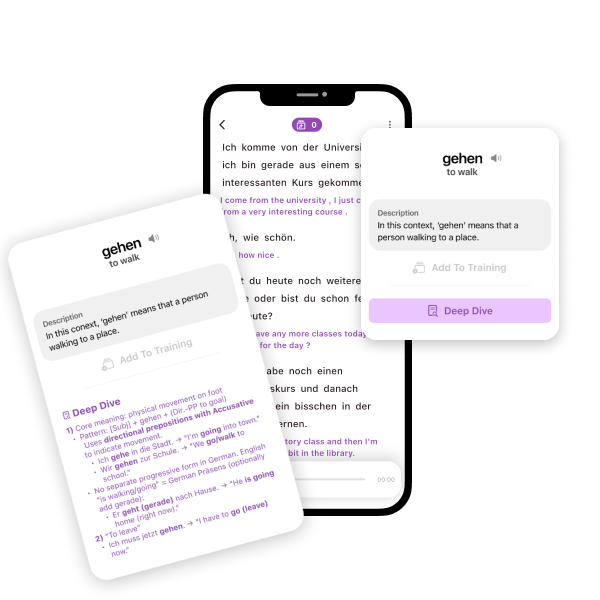
Photograph a sign, a menu or this page. LiT reads it, translates it, and sends the words you want to keep into your vocabulary trainer.
Try LiT Free

The telephone has its own opening, and it is not a greeting. Picking up with Prosím, literally please, is completely normal and sounds like nothing at all to a Slovak ear. Written down it looks like the start of a request. Spoken into a phone it just means go ahead.
On a work call people often answer with their surname instead, which carries no greeting and no politeness marker at all. If you answer that way you have given the caller nothing to work from, and they will usually open with Dobrý deň to set the register themselves.
Slovak has a goodbye reserved for people you cannot see. Do počutia means something close to until we hear each other, and it is the phone and radio counterpart of dovidenia, until we see each other. Saying dovidenia at the end of a call is not a disaster, but do počutia is the one that fits, and using it correctly is the clearest signal that you have heard Slovak spoken rather than only read it.
Slovak is heavy with accents: the acute on long vowels, the caron on č, š and ž, the small hook on ď and ť, the odd ô in words like skôr. In casual messages a great many people simply leave them off, so ďakujem arrives as dakujem and prosím as prosim. Nobody reads this as illiteracy. They read it as a phone keyboard.
What you should notice is where it stops. Accents come back in email, in anything sent to an office, and in anything a stranger will read. Writing dobry den to a landlord is a small signal, and the signal is that you did not bother.
Messages shorten the polite words and keep the functional ones. Ďakujem becomes vďaka, a full goodbye becomes two syllables, and there is a verb for the thing where you ring someone once so they call you back.
The Slovak word for no is nie. The word no is something else entirely: a filler that sits at the front of a sentence and often amounts to well, or yeah, or go on. In conversation the tone makes this obvious. In a one word reply to your message it does not, and English speakers regularly read a cheerful acknowledgement as a flat refusal.
The first mistake is sending Ahoj to someone you have only ever addressed as vy. In speech ahoj can be thrown out quickly and half swallowed. In a message it is the whole first line, and it tells the reader you have decided the two of you are on ty terms. That decision is normally offered by the older person or the more senior one, not taken by the newer arrival.
The second is mixing the two within a single message, which happens constantly when people copy a polite opener from somewhere and then write the rest from memory. Dobrý deň followed by napíš mi reads as two different people writing.
The third is treating Prosím as a written greeting. It is a telephone word and a counter word, the thing a shop assistant says to call you forward. At the top of an email it just looks like a sentence that got cut off.
Standard written Slovak is consistent across the country, so what varies is the spoken layer around it. Servus is heard more in the west and in Bratislava, where the Austro-Hungarian borrowings sit thickest; the eastern dialects around Prešov and Košice differ from standard Slovak enough that outsiders notice it immediately, although everyone writes the standard language.
The other thing that surprises people is Czech turning up in Slovak chats. Slovak and Czech are close enough that speakers of each generally understand the other, and it is unremarkable for one person to write in Czech and the other to answer in Slovak without either switching. Some texting shorthand travels the same route, which is why a Slovak chat can contain words you will not find in a Slovak dictionary.
Slovak email has a middle register that spoken Slovak does not really need. Zdravím, roughly greetings, is extremely common at the top of messages between people who are neither strangers nor friends: a colleague in another department, someone you have met twice. It buys you a little distance without the full formality of Dobrý deň.
One convention has no spoken equivalent at all. In letters and careful email, the polite pronouns are capitalised out of courtesy: Vy, Vám, Vás, Váš. Nothing in the pronunciation changes, and you will never hear it. If you write to an office in lower case nobody will mention it, and if you write it capitalised the reader will register that you know how Slovak correspondence works.
| Phrase | Where it belongs | Who you say it to |
|---|---|---|
| Dobrý deň | Spoken, email, any first contact | Anyone, vy |
| Zdravím | Email and messages | Colleagues, acquaintances |
| Ahoj / Ahojte | Spoken and messages | Friends, one or many, ty |
| Prosím? | Answering the phone only | Anyone |
| Do počutia | End of a call only | Anyone |
| Dovidenia | Leaving in person | Anyone, vy |
| Maj sa / Vďaka | Messages and casual speech | Friends, ty |
| S pozdravom | Written sign-off | Anyone, vy |
Learn Dobrý deň for anything written to a stranger, Prosím for the moment the phone rings, and Do počutia for the moment you hang up. Those three cover the registers where a mistake is visible.
Ahoj and vďaka can wait until somebody uses them on you first. In Slovak the move from vy to ty is offered, and in writing there is nothing to hide it behind.

Small talk in Slovakia follows a script. Here are the five questions strangers open with, and the answers that keep the conversation alive.
A price on a Slovak label and a price said out loud are two different things. Here is how euro becomes eura becomes eur, and what to say at a market stall.
Алло is not hello, brackets do the work of smileys, and names change shape when someone calls you.