
Ukrainian Intermediate Vocabulary
How Ukrainian changes on the phone and in texts
Алло is not hello, brackets do the work of smileys, and names change shape when someone calls you.
Алло is not hello, brackets do the work of smileys, and names change shape when someone calls you.
Most Ukrainian courses give you Привіт and Доброго дня and leave it there. Both are real, both are useful, and neither is what you say when the phone rings. Ukrainian on a call starts with a word that is not a greeting at all, and in a messaging app it loses the greeting, the punctuation and half the letters.
This matters more in Ukrainian than it does in English, because the language carries a lot of its politeness in word endings. Take away the face and the tone of voice and the endings are all you have left. A clipped reply that would read as rude in an email is completely normal in a Telegram chat, and the same sentence typed to a landlord instead of a friend changes meaning entirely.
One note on the respellings below. Ukrainian г is a voiced h, not a g, so it is written as h throughout, and и is a short sound somewhere between the vowels in bit and but. The respellings will get you close enough to be understood and no closer.
You answer the phone with Алло. It is not hello, it has no life outside a phone call, and nobody says it face to face. If the number is unknown you will also hear Слухаю, which means I am listening, and functions the way speaking does in English.
Доброго дня and Добрий день are both widely used and the choice between them is genuinely argued over. Добрий день is the older form and some editors still prefer it; Доброго дня is everywhere in speech and on the phone. Nobody will misunderstand either. Доброго ранку is the normal morning form and Добрий вечір the normal evening one, which is why the set looks inconsistent when you first meet it.
In Ukrainian the person who dialled is expected to do the work. You name yourself early, usually in the first sentence, and you check that the other person can actually talk before you start. Skipping that second step is the thing that marks out a foreign caller faster than any accent.
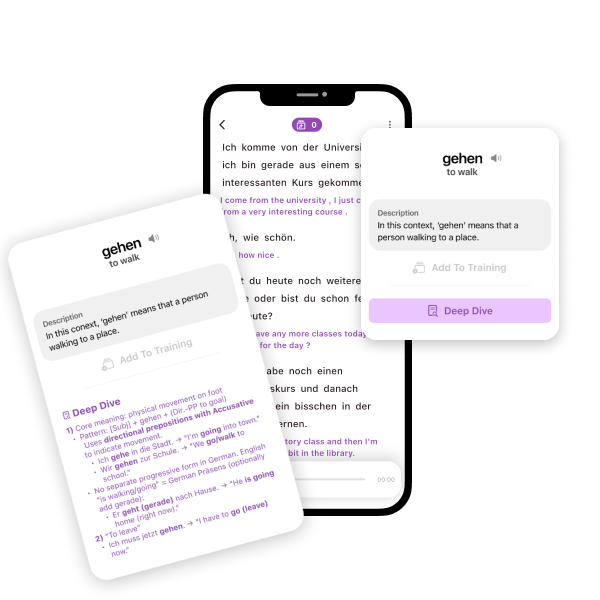
Photograph a sign, a menu or this page. LiT reads it, translates it, and sends the words you want to keep into your vocabulary trainer.
Try LiT Free

The useful thing here is grammatical. Ukrainian does not say I cannot hear you. It says you are not audible, with no subject at all, and the person becomes the object: вас, meaning you, in the accusative. Once you notice that pattern you will hear it constantly, because it covers most of what goes wrong on a line.
До зв'язку is the one worth learning first, because it is the rare phrase that works identically in speech and in writing. It means until we are in contact and it closes a call, a chat and a work email without changing register. Всього доброго is the polite version for someone you do not know. With friends the call simply ends on Бувай, the informal bye, with Бувайте for a group or for politeness.
Text in Ukraine mostly means Viber or Telegram rather than SMS, and the register there is much closer to speech than to letter writing. Messages open with Привіт and nothing else, or with no greeting at all if the conversation is already running. Younger texters clip it to прив, which exists only on a screen; saying it out loud would be a joke.
Voice notes do a lot of work here, which is why that last phrase is worth having. A long explanation that would take five typed messages tends to arrive as thirty seconds of audio instead, and the reply comes back the same way.
This is the convention no phrasebook will show you. A closing bracket on its own, with no colon and no eyes, is the standard smile: добре) reads as a warm fine. The number of brackets is the volume. One is friendly, three or four is real amusement. A lone opening bracket is the opposite and means that something is a shame. Written laughter is spelled with х, not h.
Two more habits of typed Ukrainian. The apostrophe in words like зв'язок and п'ять is frequently dropped in casual messages, so do not be thrown by звязок. And a short reply closed with a full stop reads as cooler than the same word without one, which is why most friendly messages have no final punctuation at all.
Do not answer an unknown number with Привіт. It is the ти register, the informal singular, and using it on an official, a landlord or a doctor lands the way clapping a stranger on the shoulder lands. The same rule governs the endings: Бувай to a stranger is wrong where Бувайте is right, and Вам зручно говорити is right where Тобі зручно would be too familiar.
Do not type Алло into a chat as a greeting. In writing it only ever means are you still there, the way a doubled hello does in English, and it comes across as prodding. Do not start a call by launching into your question without naming yourself either; the silence where your name should have been is noticeable.
One more worth knowing. Доброго вечора has picked up a second life since 2022 as the opening of a line almost everyone in the country can finish. Using it is completely normal, but do not be surprised if someone answers with the rest of it.
Everything above works across the country. What varies is what sits alongside it. In Galicia and the west you will hear Добридень, a contracted good day, and in religious households and villages the greeting is a different thing entirely: Слава Ісусу Христу, with the fixed reply Слава навіки. It comes in pairs, and knowing only the first half leaves you stuck.
The other variable is not regional so much as personal. Ukraine is widely bilingual and plenty of people switch between Ukrainian and Russian on a call depending on who answered. Opening in Ukrainian is never the wrong move, and if the other person continues in Ukrainian you simply carry on.
Email and letters are a separate register with rules of their own. Addressing one person politely, you capitalise Ви and its forms, including Вам and Вас, mid sentence. In a casual chat nobody bothers. The opening is Шановний for a man and Шановна for a woman, and the ending has to agree with the person you are writing to.
Then the name changes shape. Ukrainian keeps a vocative case, so a person being addressed is not called by the dictionary form of their name: Олена becomes Олено, Іван becomes Іване, пан becomes пане. You will hear the same thing on the phone when someone addresses you directly, and it is why your own name may sound unfamiliar for a second.
| Situation | What you say |
|---|---|
| Answering an unknown number | Алло, or Слухаю |
| Calling an office or a stranger | Доброго дня, це [your name] |
| Checking the timing is right | Вам зручно говорити? |
| The line is breaking up | Вас погано чути |
| Closing a call | До зв'язку, or Всього доброго |
| Opening a message to a friend | Привіт, or nothing at all |
| Opening an email to a stranger | Шановний пане / Шановна пані |
| Closing an email | З повагою |
Learn Алло, Доброго дня and До зв'язку and you can open and close almost any call in Ukrainian without sounding like a textbook. Add Вас погано чути, because the line always does that eventually.
The rest arrives from reading other people's messages: the stray brackets, the missing apostrophes, the voice note instead of a paragraph. None of that is in a phrasebook, and all of it is on the screen in front of you.

The Ukrainian lines for symptoms, medicines, theft and getting lost, including the gender endings and the numbers that decide what you say first.
In Ukrainian a shifted stress or a wrong ending does not sound foreign, it says something else. Here are the beginner errors that change the meaning.
Slovak carries formality in its verb endings, and a text message strips away every clue that usually softens it.