
Slovenian Beginner Vocabulary
Slovenian Words That Don't Survive Translation
Izvolite, malica, priden and the dual: the words you will hear in your first week in Slovenia, and what the English version quietly throws away.
Izvolite, malica, priden and the dual: the words you will hear in your first week in Slovenia, and what the English version quietly throws away.
Every word in this article has an English translation. That is exactly the trouble with them. The dictionary entry is accurate and almost useless, because the English word is something you may say if you feel like it, and the Slovenian word is something you are expected to say, at a particular moment, to whoever happens to be standing there.
None of these are exotic. You will meet all of them in your first week: behind a counter, at a table at noon, in a doorway, in the two seconds after someone sneezes. What makes them hard is not the sound. It is that the gap where they belong is, in English, usually silence.
A word on the respellings below. Slovenian stress is not fixed and it is not marked in ordinary writing, so the capitals here show where the beat usually falls and nothing more. Treat č as ch, š as sh, ž as the s in measure, j as y, and c as ts. A v at the end of a word drifts towards a short oo, so pozdrav ends closer to pozdrau than to the English v.
Izvolite is the first word you will hear in a bakery, a post office, a pharmacy and a ticket window, and it is the one learners misread most often. It is not a greeting and it is not a question about your health. Depending on the moment it means here you are, go ahead, after you, come in, or what can I get you. It is handed to you as a signal that the floor is now yours.
Prosim covers the rest of the counter. It is built on prositi, to ask or to request, and it means please, you are welcome, and also sorry, I did not catch that. Said with a rising tone it is a polite request to repeat. Said flatly as you hand over a coffee it is roughly there you go. One word, four jobs, and no English equivalent that does all of them.
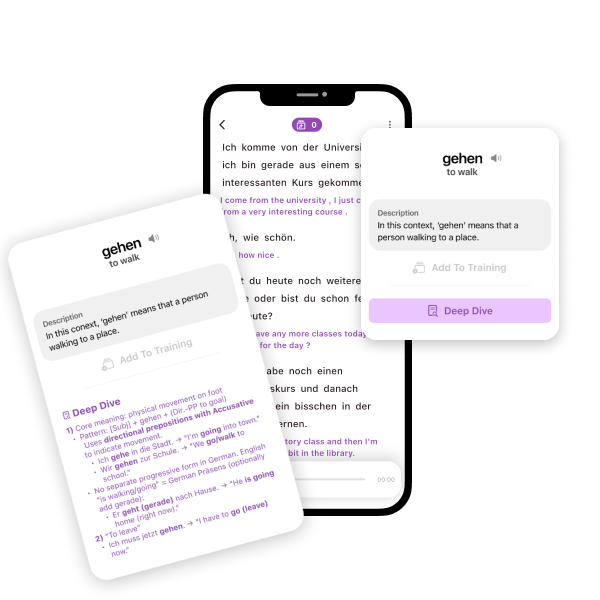
Photograph a sign, a menu or this page. LiT reads it, translates it, and sends the words you want to keep into your vocabulary trainer.
Try LiT Free

Translate malica as snack and you lose the institution behind it. It is a mid-morning meal, and it is a break, and it is a slot in the day that schools and workplaces are built around. Children eat malica at school. Offices empty out for it. Employees in Slovenia have a right to a meal allowance as part of their pay, and malica is the word around which that whole arrangement is organised.
It shows up on menus too. Many restaurants advertise a fixed, cheaper midday plate under this name, often with soup included, and it is a different thing from an evening meal at the same place. If you read the board as snack you will walk past the best value lunch in the street.
Priden is said to children, to dogs, to students and to adults, and English splits it into two words that do not overlap. Diligent gets the work in and loses the warmth. Good gets the warmth and loses the work. Priden means both at the same time: hard working and well behaved, approvingly, in one breath. It changes ending with the person, so a boy is priden and a girl is pridna.
The trap is who you point it at. To a child, a pet or a friend who has finally fixed the bike, it is affection. To an adult stranger it lands like good boy, and people notice. Keep it for children and for people who already know you are joking.
Slovenian keeps a dual number alongside singular and plural, and it is not a museum piece. It is how people speak every day. There is one set of forms for exactly two people and another for three or more, and the verb changes with them, so you can hear the size of a group before anyone counts.
English has no way to carry this. We two is clumsy and says something extra, usually that you are excluding somebody. In Slovenian it says nothing extra at all, it is simply correct, and the clumsy option is leaving it out. Nouns follow the same pattern, which is why two beers does not take the plural ending you would expect from the plural.
You do not have to produce it in week one. You do have to recognise it, because when somebody turns to you and says greva, they have already told you that the invitation is for you and for nobody else in the room.
Dober tek is said before anyone eats, including by a colleague walking past your table and by a waiter putting the plate down. Tek is appetite, so it is a wish rather than a greeting. Nothing in English occupies that slot; bon appétit is borrowed precisely because we never had our own. The reply is hvala, or enako if the other person is about to eat too.
Srečno is the one that catches people out, because the English equivalents are split across good luck, safe travels and go well. It comes from sreča, which itself covers both luck and happiness without distinguishing them. You say srečno to somebody leaving, especially if there is a drive, an exam or a journey ahead.
Slovenian is a small language with an unusual amount of internal variation. The dialects are traditionally sorted into seven groups and dozens of local varieties, and speakers from opposite ends of the country can struggle with each other's home speech. Standard Slovenian, the one on the news and in classrooms, is understood everywhere and is what you should learn, but it is not what most people speak at the kitchen table.
In and around Ljubljana, colloquial speech swallows vowels and turns a final written l into a u sound, so bil comes out closer to biu and rekel closer to reku. Towards the coast you will hear Italian borrowings and čau used for both hello and goodbye. Prekmurje, in the far northeast, is the most distinct of all and historically had its own written tradition. Colloquial speech across the country also carries old German borrowings that never made it into the standard, and you will hear more of them in the north and east.
None of this means your textbook words will fail. Izvolite, prosim and dober tek are the same in every valley. What changes is the vowels around them and the slang on either side, so expect to understand the greeting and miss the sentence that follows it.
The register mistake is not a word, it is a pronoun. Slovenian separates ti for one person you know from vi for a stranger, an official, a shopkeeper or anyone noticeably older, and the practice of using vi has its own name, vikanje. The verb agrees, so the choice runs through the whole sentence. Nobody will correct you. They will simply keep answering you with vi.
Note that even this sentence is in the dual, because it concerns exactly two people. The move down to ti is offered rather than taken, usually by the older or more senior person. Until it is offered, vi costs you nothing.
Two more. Priden pointed at an adult you have just met is patronising, as above. And a great deal of casual swearing in Slovenia is borrowed from Bosnian, Croatian and Serbian; it is everywhere in relaxed speech and it carries a different weight coming from somebody who has been in the country a fortnight. Many Slovenes understand those languages well, which does not make opening a conversation in one of them a neutral choice. English or careful Slovenian is the safer start.
Slovenians often do not answer the phone with a greeting at all. Prosim is normal, halo is normal, and giving your surname is normal, particularly at work. A company line will usually open with the company name and then prosim. As the caller, greet with dober dan and say who you are immediately, because you have been given nothing to work with.
In writing, one abbreviation does more work than any other. Lep pozdrav, literally a nice greeting, closes messages from a text to a colleague up to a reasonably formal email, and it is shortened to lp or LP so routinely that the full form can look stiff. English has no single sign-off that stretches that far.
The other thing that happens on a phone screen is that č, š and ž lose their marks, so čau is typed cau and živjo is typed zivjo. Readers restore them from context without thinking about it, and nobody will judge you for writing that way while you are still finding the characters on your keyboard.
| Word | When it comes out |
|---|---|
| Izvolite | Handing something over, or being asked what you want |
| Prosim | Please, you're welcome, and sorry, I missed that |
| Malica | The mid-morning meal, at school, at work, on a lunch board |
| Dober tek | Anyone within earshot is about to eat |
| Na zdravje | A glass goes up, or somebody sneezes |
| Srečno | Parting, when the other person has a journey or a test ahead |
| Priden | Praising a child or a dog, not an adult stranger |
| Lep pozdrav | Closing almost any message you write |
Learn izvolite and prosim first, because between them they cover every counter you will stand at. Add dober tek so you are not the silent one at the table, and srečno so you have something to say to a person walking out of the door.
The rest arrives on its own, attached to the moment it belongs to, which is the only way these words were ever going to stick.

Živjo, dober dan and pozdravljeni are not interchangeable, and Slovenian has a separate greeting for exactly two people. Here is who gets which.
The dual, the cases and one small vowel. Six beginner slips in Slovenian that do not just sound foreign, they tell the other person something you never…

Saudade, cafuné, gambiarra and the other words you will hear in your first week in Brazil, with what they literally say and what they actually do.