
Slovenian Beginner Vocabulary
Slovenian Greetings and Who You Can Say Them To
Živjo, dober dan and pozdravljeni are not interchangeable, and Slovenian has a separate greeting for exactly two people. Here is who gets which.
Živjo, dober dan and pozdravljeni are not interchangeable, and Slovenian has a separate greeting for exactly two people. Here is who gets which.
The first Slovenian word most people learn is živjo, and it is the one you can use with the smallest number of people. It is warm, it is everywhere, and it is wrong in a bank, wrong at the post office counter, and wrong when a neighbour thirty years older than you holds the door.
There is a second problem that no phrasebook mentions. Slovenian still uses the dual, a grammatical number for exactly two, and it is alive in ordinary speech rather than preserved in poetry. So you are not only choosing between polite and familiar. You are also counting the people in front of you, and the answer changes if there are two of them rather than three.
Tap play on any phrase below and say it back. The respellings mark the stressed syllable in capitals, because Slovenian stress is not predictable from the spelling. Some varieties of Slovenian also distinguish pitch on stressed syllables, and no English respelling can carry that, so treat these as a starting point and let the audio correct you.
If you learn one greeting, learn this one. Dober dan is neutral, polite, and correct with a stranger of any age, in any shop, office or waiting room. Nobody will ever think less of you for using it.
These three are tied to the clock rather than to the relationship, which is why they are safe. There is also a habit worth copying: when you walk into a small shop, a bakery or a doctor's waiting room, people greet the room, not a particular person. Dober dan said to nobody in particular is normal, and silence is the thing that gets noticed.
These are the informal three, and they all double as goodbye. Živjo shares a root with živ, alive, which is a useful hook for remembering it. Čau is the Italian ciao, naturalised and spelled the Slovenian way.
The line between these and dober dan is the same line that separates ti from vi. Slovenians call it tikanje and vikanje, and it is a real social boundary rather than a grammatical footnote. You use ti with friends, family, children and usually with people your own age in casual settings. You use vi with everyone else until they tell you otherwise, and that invitation is normally given explicitly, often by an older person to a younger one.
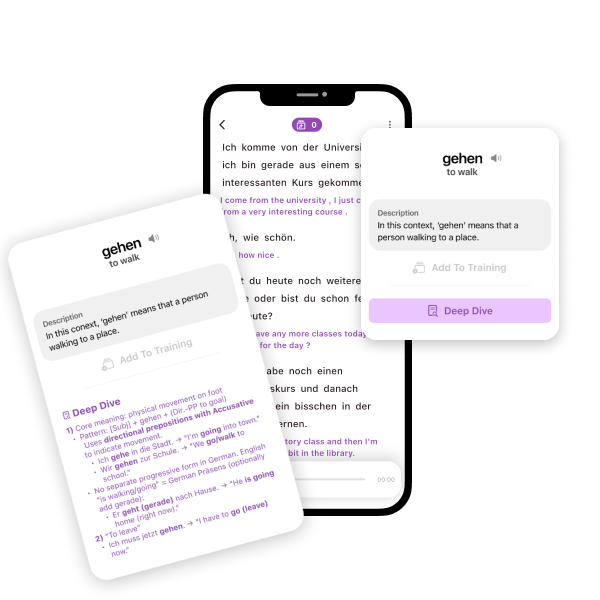
Photograph a sign, a menu or this page. LiT reads it, translates it, and sends the words you want to keep into your vocabulary trainer.
Try LiT Free

Pozdravljeni is the greeting you will see on signs, hear in announcements and read at the top of emails. It is built from pozdrav, a greeting, and it behaves like an adjective, which means its ending changes with the number and gender of the people you are addressing. This is where the dual appears.
Read that second card again. Pozdravljena is both the form for one woman and the form for two men, which surprises everyone. A mixed pair takes the masculine, as mixed groups always do in Slovenian. And pozdravljeni is doing three jobs at once, because the polite singular borrows the plural form, exactly as vous does in French.
The practical consequence is that the ending leaks information about how close you are. Say pozdravljena to a woman you have just met and you have used the ti form. Say pozdravljeni to the same woman and you have been polite. If you cannot do the arithmetic fast enough, fall back on dober dan, which has no endings to get wrong.
The follow-up question splits the same three ways, and this is the clearest place to watch the dual working. The verb biti has si for one person, sta for two, and ste for three or more and for the polite singular.
Keep the answer short. Kako ste from a shop assistant or a receptionist is a courtesy, not an invitation, and dobro, hvala closes it neatly before you say what you actually came to say.
Na svidenje is the polite goodbye and it means something like until the seeing, the same construction as auf Wiedersehen. Adijo comes from the Romance farewell and is informal. Lahko noč is built from lahko, meaning easy or light, so it is literally an easy night.
Se vidiva is the dual again, and it is the one learners get wrong most often because it feels like a fixed phrase. Said to two or more people it has to be se vidimo. If you are saying goodbye to a couple, se vidiva tells them you only plan to see one of them.
The first mistake is živjo at a counter. Post offices, pharmacies, ticket windows and municipal offices all run on dober dan, and the informal greeting with someone performing an official role lands the way first-naming a stranger lands in English. Nobody will correct you. They will simply switch into the voice they keep for tourists.
The second is reaching for ti because the person seems friendly. Age does most of the work here: an older person may move you both to ti, and once they have, staying on vi starts to look cold. Going the other way, from ti back to vi, is awkward, so start formal.
The third is lahko noč on arrival. It looks like the evening partner to dobro jutro and it is not. Walking into a restaurant at nine in the evening with lahko noč announces that you are leaving. The arrival word is dober večer.
Slovenia is small and its dialect map is not. The standard greetings on this page are understood everywhere, and what shifts is which informal one people reach for first. In the Primorska region and along the coast, where Italian has been a neighbour for centuries, čau and adijo are thoroughly at home. In parts of the northeast, towards the Austrian border, you will hear a colloquial servus borrowed from German, used the way čau is used elsewhere.
Zdravo is worth a note of its own. It is standard Slovenian and completely ordinary, and it is also shared with Croatian, Bosnian and Serbian, so some speakers hear a regional or generational colour in it that others do not. Nobody will object to it among friends. If you want a greeting with no shading at all, dober dan has none.
Slovenians do not usually answer the phone with a greeting. The normal answer is prosim, which means please, said with the rising tone of a question. It sounds abrupt written down and is entirely unremarkable spoken. In an office you will often hear a surname instead, and on a mobile where the caller is already named on the screen, a friend gets živjo.
Writing splits the register again. A formal email does not open with any of the greetings above. It opens with spoštovani, the Slovenian equivalent of dear, which carries the same gender and number endings as pozdravljeni: spoštovani to a man or a group, spoštovana to a woman. A friendlier email can open with pozdravljeni and nothing is lost.
Two details from Slovenian email you will not work out on your own. The v at the end of pozdrav is pronounced like an English w, so the sign-off ends closer to pozdraw than pozdrav. And in formal writing the polite pronouns Vi, Vas and Vam are often capitalised mid-sentence as a courtesy to the reader, which is why those capitals keep appearing where English would not put them.
| Greeting | Register | Who | Arriving or leaving |
|---|---|---|---|
| Dober dan | Neutral to formal | Anyone, including strangers | Arriving |
| Dobro jutro | Neutral | Anyone, until mid-morning | Arriving |
| Dober večer | Neutral to formal | Anyone, from early evening | Arriving |
| Pozdravljeni | Neutral to warm | A group, or one person politely | Arriving |
| Živjo | Informal | Friends, peers, children | Both |
| Zdravo | Informal | Friends and peers | Both |
| Čau | Very informal | Close friends | Both |
| Na svidenje | Neutral to formal | Anyone | Leaving |
| Adijo | Informal | Friends and peers | Leaving |
| Lahko noč | Neutral | Anyone, late at night | Leaving |
Learn dober dan, na svidenje and živjo first, in that order, and you can greet and leave anyone in Slovenia without causing a flicker. Add pozdravljeni once you are comfortable counting the people in front of you, because that is the form that teaches you the dual.
The rest arrives by ear. Listen for whether a stranger says si or ste to you, and answer in the same number they chose.

Izvolite, malica, priden and the dual: the words you will hear in your first week in Slovenia, and what the English version quietly throws away.
The dual, the cases and one small vowel. Six beginner slips in Slovenian that do not just sound foreign, they tell the other person something you never…
Bosnian has a hello for every distance between two people. Here is which one fits a stranger, a neighbour, a friend, and a text message.